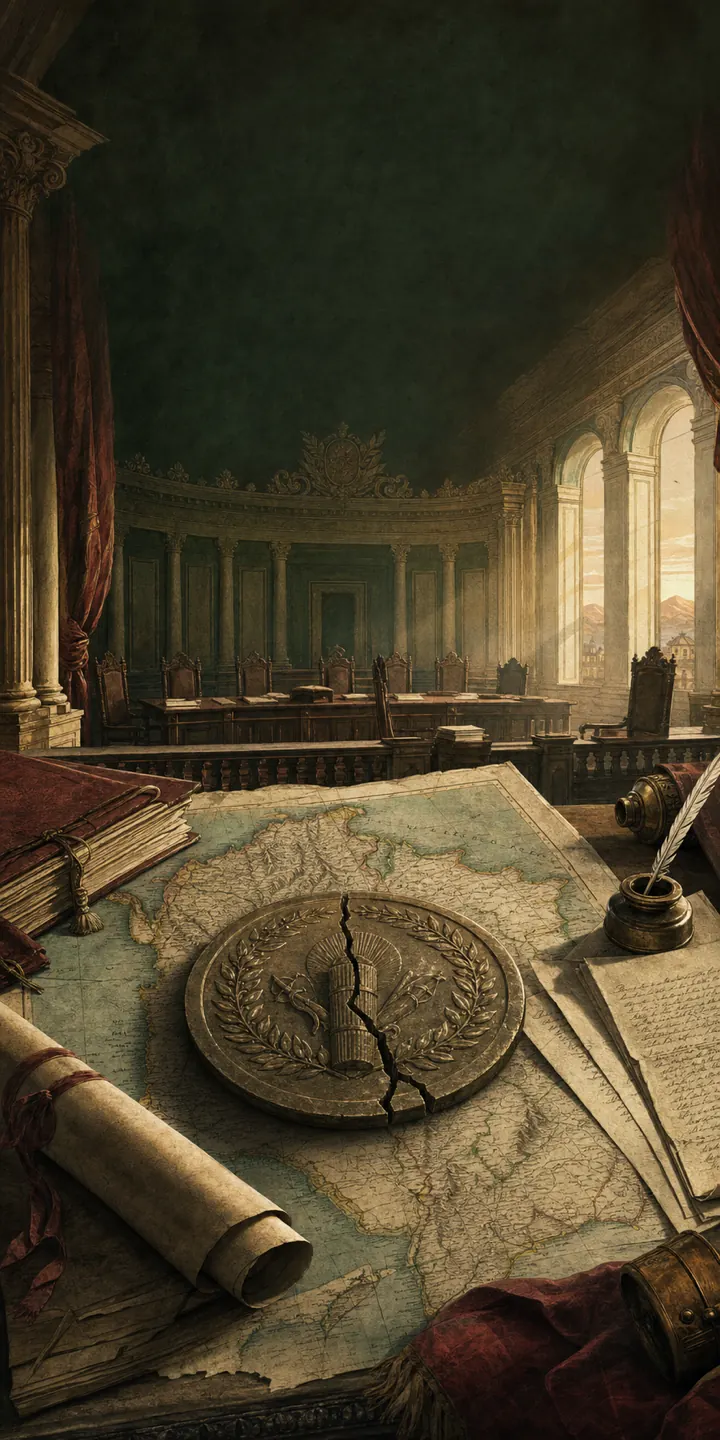
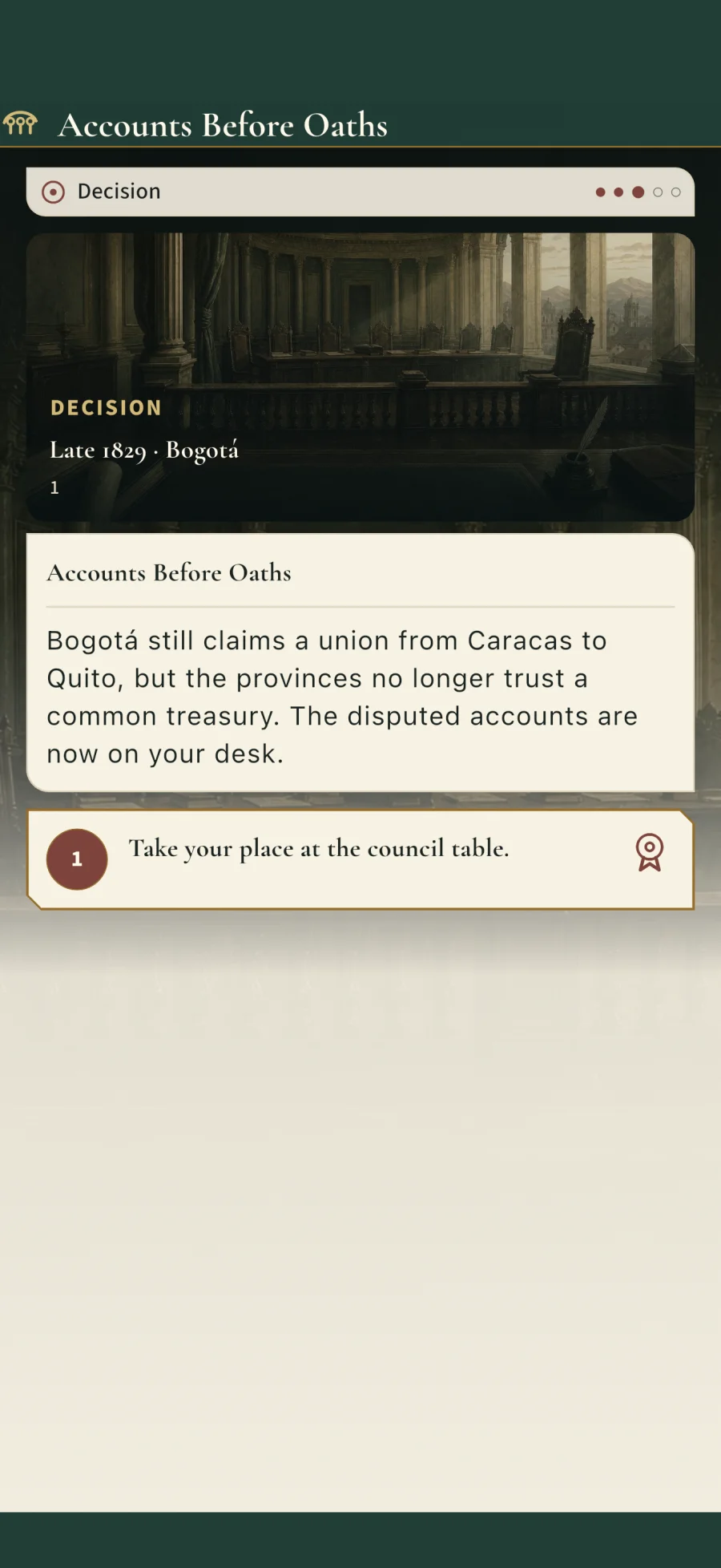
A fragile republic turns to you for advice after independence. Leaders, witnesses, and the secretary you choose bring competing needs to the table. Read their dispatches, ask what is missing, and decide which proposal you can defend.
Serve as an unnamed adviser in a fictional historical what-if strategy adventure set in nineteenth-century South America, centered on Venezuela and Gran Colombia. Negotiate with competing interests as the new state faces the pressures that follow independence.
Decisions affect legitimacy, stability, justice, sovereignty, and credibility. Choose a secretary and governing approach, equip policy templates, and reconsider your plans when a challenge fails.
Explore 25 chapters across five historical routes. Knowledge retained from earlier decisions can open new choices; evidence, current capabilities, and negotiation results determine which replies are available. Routes are discovered through choices, not assigned automatically by playthrough number. A new route begins only when you choose it.
Policy, diplomacy, persuasion, and other deterministic challenges.
Failure feedback that helps you consider another approach.
Discoverable historical routes with titles, archives, policies, doctrines, and illustrated endings.
Play on iPhone and iPad
The opening two chapters are free. One non-consumable purchase grants access to the remaining content. Routes must still be discovered through choices, and chapters open through story progress. No ads, subscription, or account is required. Offline play is available after purchase verification.
You serve as an unnamed adviser. Around the council table, a law, a supply ledger, and a provincial petition may describe the same decision very differently. Your guides and counterparts bring those differences into view.
Your guides: fictional characters
Each guide offers a different way into the record. Choosing one does not lock you out of any scene or ending.
Chronology and disputed claims
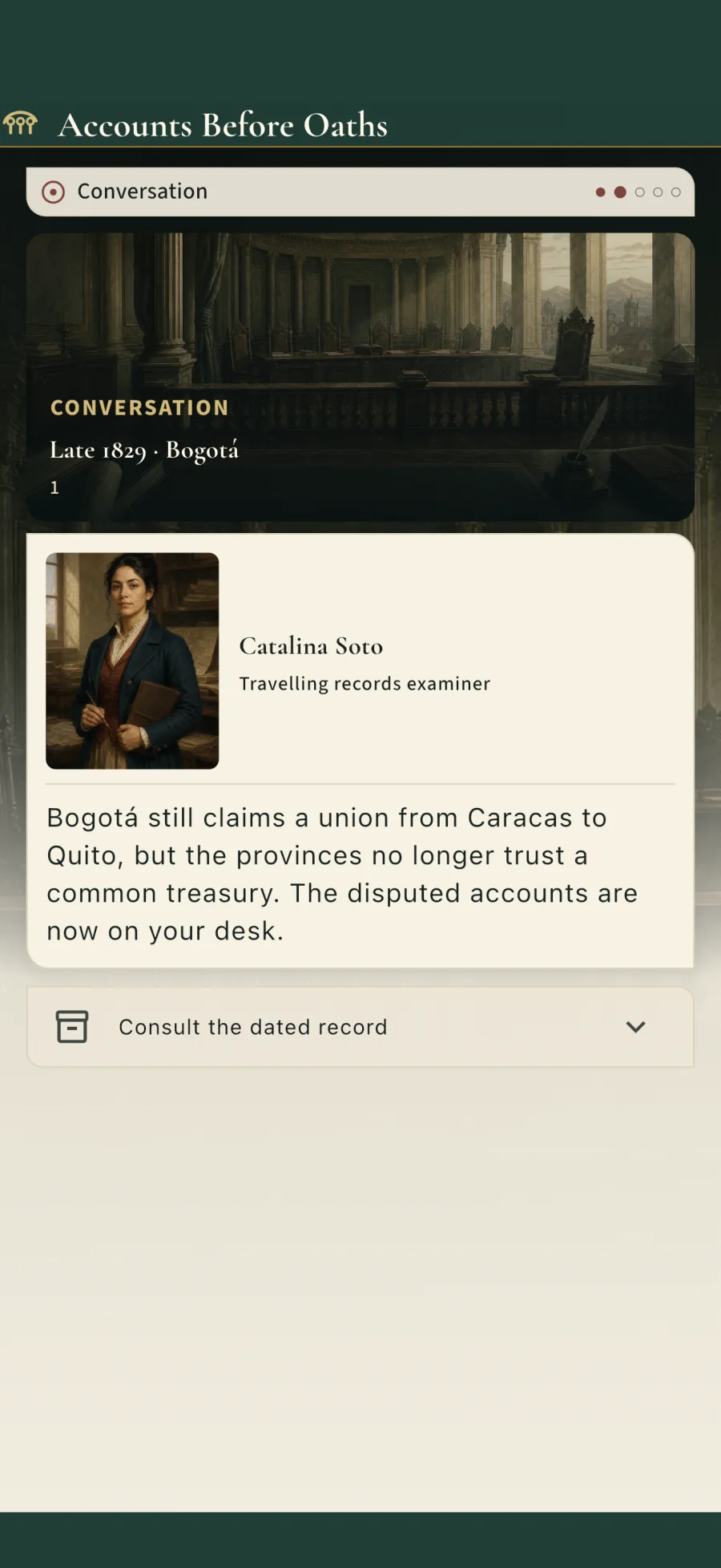
Catalina Soto
A travelling records examiner, Catalina places decrees, debts, and disputed dates in order before you decide. She offers the fullest chronological explanation, while keeping dated evidence separate from the council's proposal. Precision is her strength; practical support is more limited.
Archive clerk
Tomás Vale
Tomás begins where one order conflicts with another. He follows contradictions between decrees and later records, making divided authority easier to see. His concise account is useful at a crowded council table, but the wider context still matters.
Provincial schoolteacher
Lucía Paredes
Lucía follows each rule to the clerk, petitioner, or family who must use it. She makes institutions understandable by asking how rights are taught and administered. Her practical perspective brings everyday access into view without replacing the legal record.
Dock interpreter and trade broker
Jacinto Rojas
Jacinto reads the bargaining position of a port, envoy, or creditor quickly. He knows that a treaty clause can sound different at the dock than in the capital. His strength is the negotiation in front of you; constitutional detail still needs checking against the archive.
Quartermaster
Baltasar Quintero
Baltasar counts food, roads, and hours. He measures political promises against the supplies and capacity needed to carry them out. Keeping an office open is his immediate concern, but his dates and legal explanations should remain provisional until the records support them.
Historical figures in this story
These introductions describe the figures' roles in the game's dramatized, counterfactual scenes, not a complete historical biography. Their dialogue and your possible decisions belong to the fiction.
Law and enforceable authority
Francisco de Paula Santander
In the council exchanges, Santander presses the case for lawful duties that an exhausted institution can still enforce. A careful promise alone does not satisfy him. His questions bring the difference between writing a rule and binding the people who must obey it into focus.
Territory and regional loyalty
José Antonio Páez
Páez measures a compact against roads, revenue, command, and the loyalties of a province. His dialogue is brief and concrete. He asks whether an agreement can reach beyond the capital and offer something that regional institutions can actually use.
Knowledge and public services
José María Vargas
Vargas tests a reform by its evidence, its means of correction, and the office that must keep it working. In this story, expert confidence is only a beginning. His questions ask whether knowledge becomes a public service that citizens can reach.
Command and constitutional limits
Antonio José de Sucre
Sucre appears in the story's early constitutional crisis. His exchanges connect military command with the civilian limits written into your proposals. His perspective asks whether an instruction can be explained to the officers who must carry it out.
Recognition and treaty language
Pedro Gual
Gual brings recognition, treaty law, and diplomatic credibility to the council's choices. His exchanges ask how an account will read to envoys outside the room. A government's words must survive comparison with the instructions and records it has already issued.
Treasury and fiscal capacity
José María del Castillo y Rada
Castillo y Rada connects a constitutional promise to the treasury that must sustain it. His role keeps funding and safeguards beside the language of reform. An ambitious declaration remains a question until the administration can account for what it will cost.
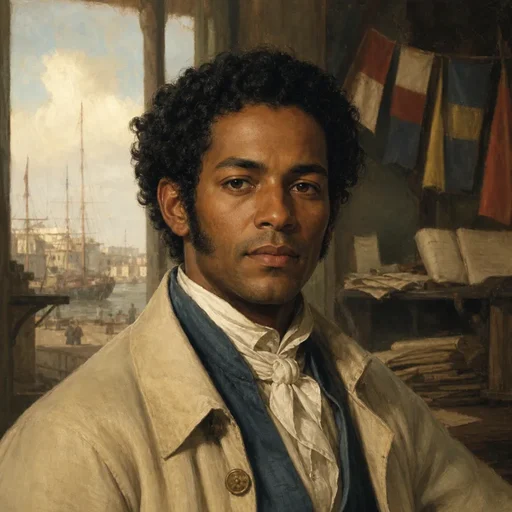
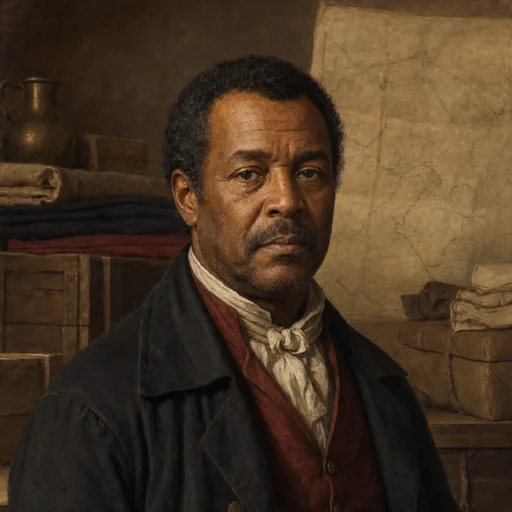
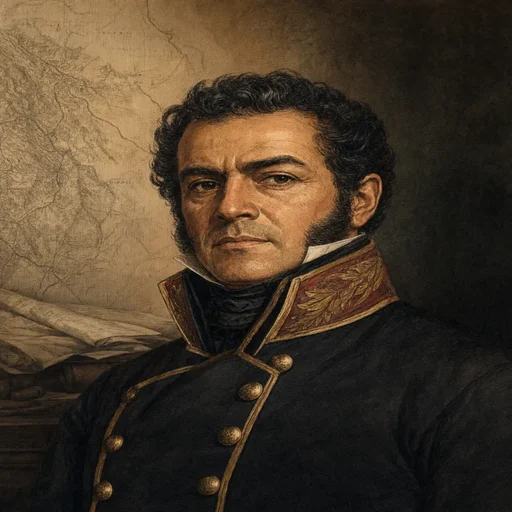
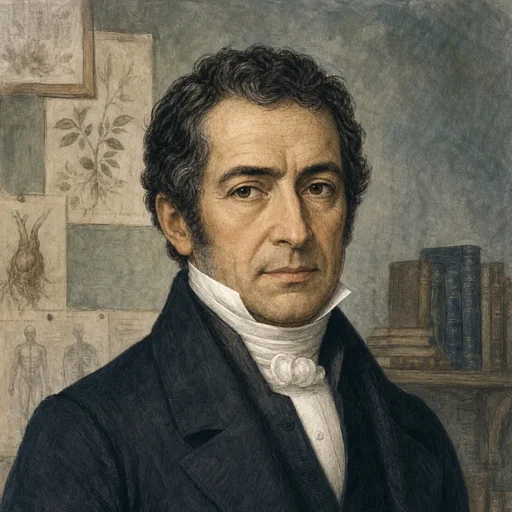
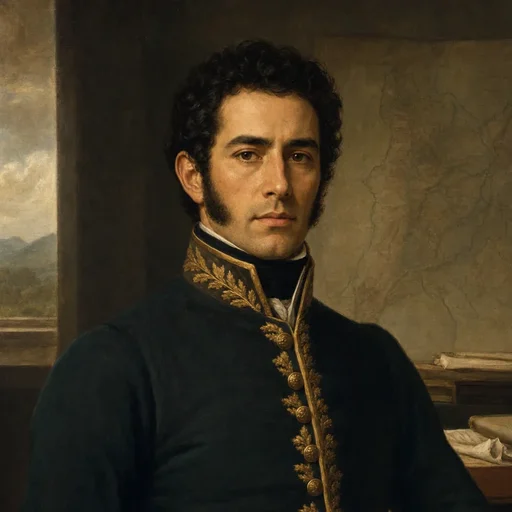
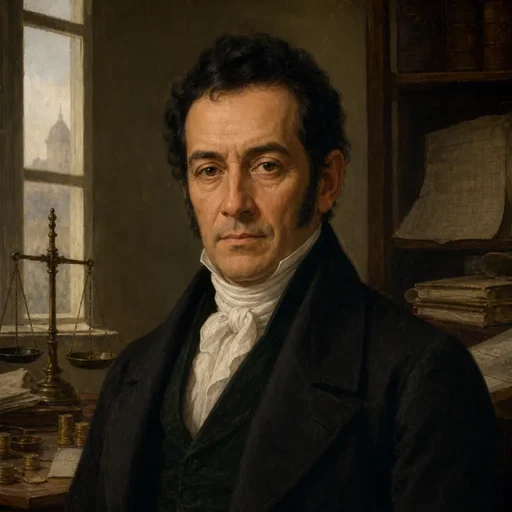
Character artwork from La República Bendita. The portraits of historical figures are artistic game depictions, not authenticated historical likenesses.
Inside the game
Meet the people behind the disputed records.Take a place at the council table.