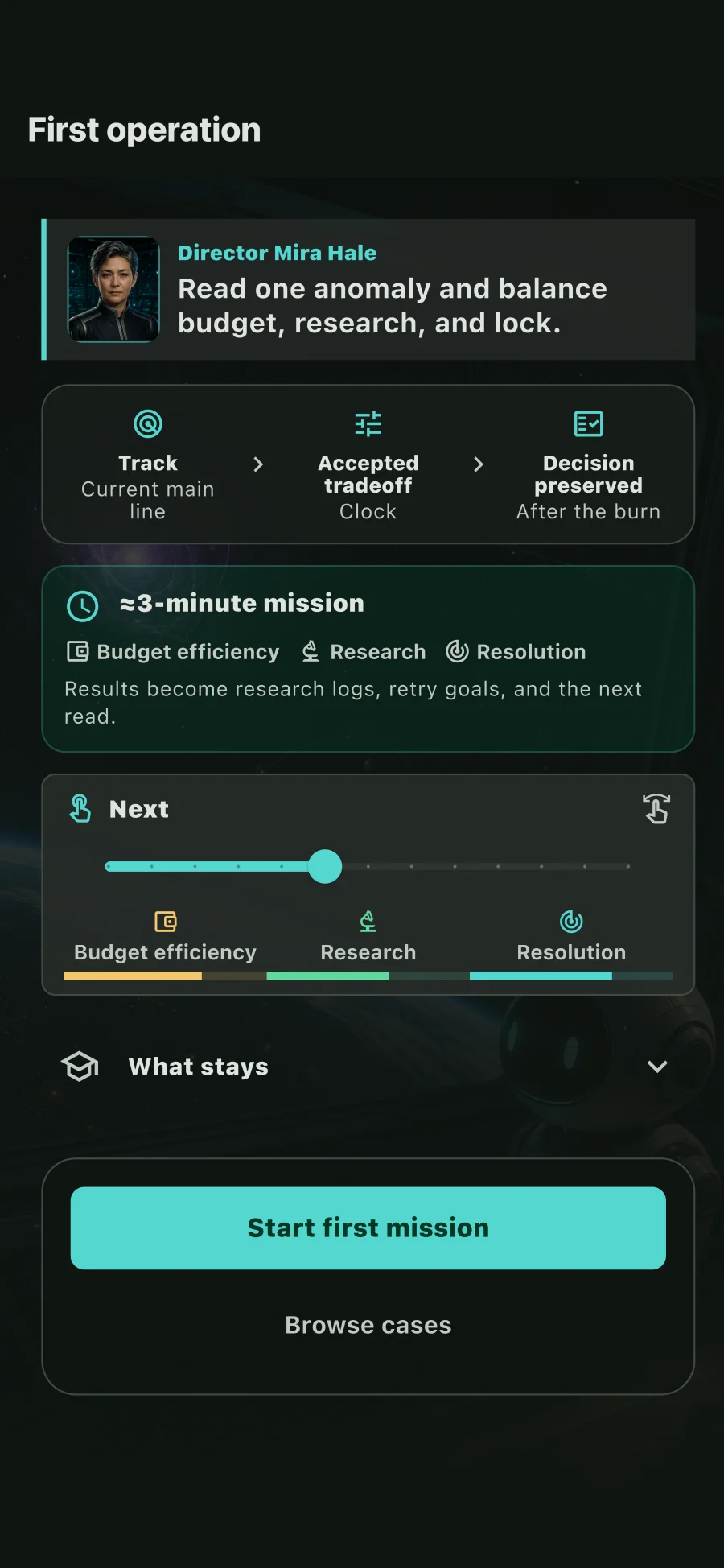
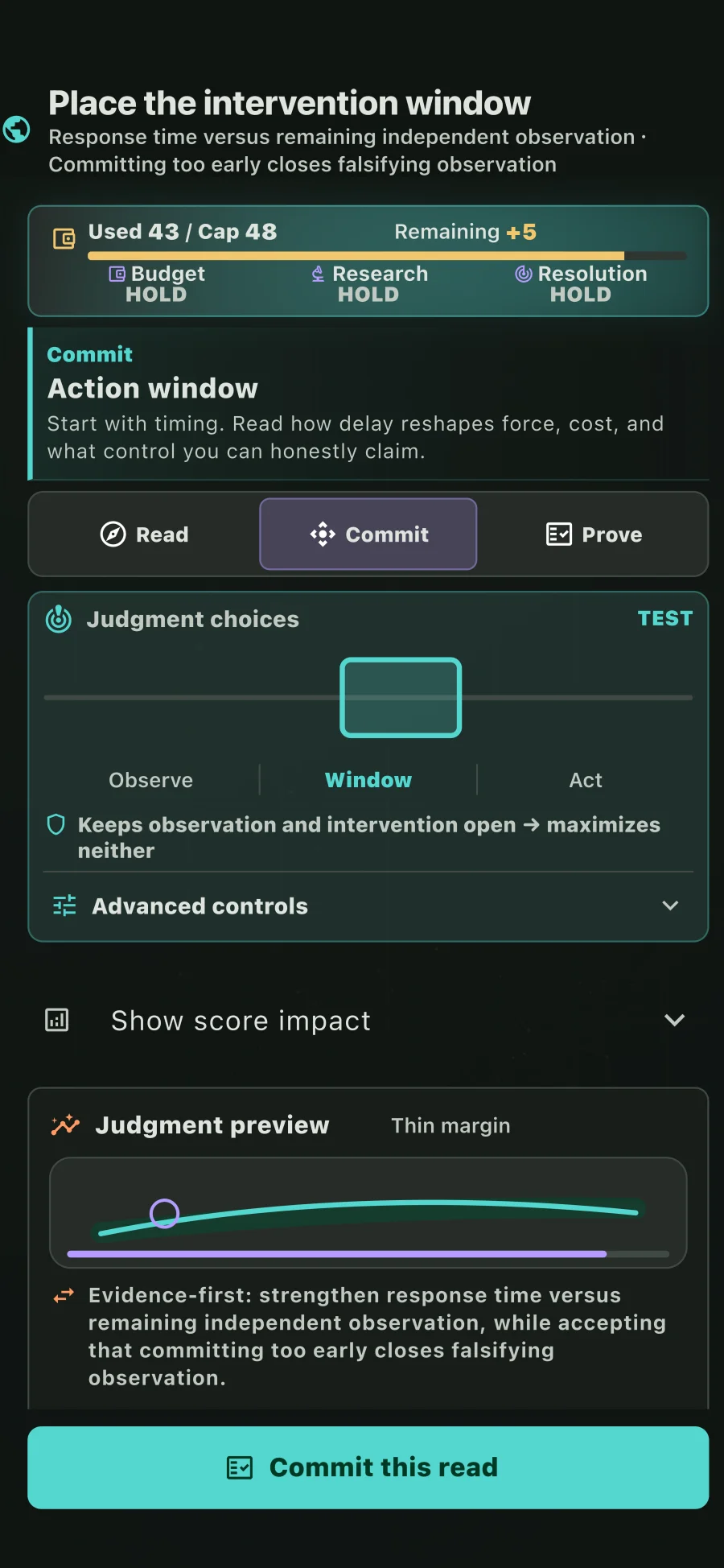
Amina checks whether a promising signal could be noise. Ravi and Camila bring different strengths to the same mission-control desk. You take the watch, weigh their evidence, and decide what to attempt with the resources available.
Stellalyzer is an offline-first space-operations strategy game. Build a plan, commit limited resources, and examine what your decisions change.
Five operation modes explore impact mitigation, signal analysis, orbital conjunctions, deep-space observation, and sample return. A branching campaign carries research gains, investments, and failed decisions forward. Planning diagrams distinguish your selected plan from recommendations, while debriefs separate preliminary results from verified findings.
Anomaly cases grounded in astronomy and space-science concepts.
Counterfactual plans and explainable mission debriefs.
A local research archive and researcher-specific records.
Campaign outcomes and short challenges to revisit.
Play on iPhone and iPad
Start with the free guided evaluation before deciding whether to unlock full access. A one-time in-app purchase unlocks the paid campaigns, modes, and archives. After purchase verification, unlocked content remains available offline. Current pricing and device compatibility are shown in the App Store.
Stellalyzer is a fictional learning game, not real mission-planning software or operational guidance.
Mission control is not a single voice. Researchers bring different priorities, a director asks what can be defended, and navigator AIs keep your reasoning in view. Their advice supports your judgment without replacing it.
The research desk and mission director
Evidence and uncertainty
Amina Ndlovu
Careful and steady, Amina separates what is known from what is still uncertain. She checks whether an apparent change could be noise and asks for enough observational support before reaching a conclusion. Her perspective keeps a promising interpretation from becoming a claim too soon.
Timing and operational risk
Ravi Perera
Ravi is action-oriented, but his urgency has a practical basis: time spent deciding is time no longer available to act. He asks what delay will cost and what room for recovery remains. His advice puts the shrinking execution window beside the quality of the evidence.
Faint traces and their source
Camila Arce
Tenacious and forensic, Camila keeps weak traces in view until their value has been tested. She follows what a model leaves out as carefully as what it explains. Her perspective asks whether an overlooked detail deserves another comparison before it is discarded.
Mission director
Mira Hale
Mira sets the mission's questions without making your scientific conclusion for you. She asks which judgments can be defended responsibly, where a plan may break, and what record will remain for the next watch. Urgency does not remove the need for an explainable decision.
Navigator AIs
Procedure, navigation, and records
PiPi
Warm and exact, PiPi handles navigation and shift records while leaving the interpretation to you. It keeps the reasons for a decision connected to the procedure that follows. A familiar voice on watch is useful company, not a substitute for checking the evidence.
Patterns without premature intent
SaSa
SaSa is conversational and cautious. It notices unsettling regularity, then asks what comparison could test it. A pattern may justify concern without establishing a purpose; SaSa keeps those two claims apart while helping you consider the next observation.
Assumption testing and red team
LoLo
Blunt but fair, LoLo tests the explanation most likely to fail under the actual conditions. It challenges assumptions and asks whether a plan still works when the comfortable reading is removed. Its objections are a chance to strengthen your reasoning, not an answer to accept automatically.
Character artwork from Stellalyzer. These are fictional characters in a learning game, not real mission personnel.
Inside the game
Begin a guided mission.Balance the timing and cost of an intervention.